Calheta vs Funchal Whale Watching: Which Port Is Better?
We earn a commission when you book through our links on Viator (PID P00303273), at no extra cost to you. This is how we keep the site free.
I'd heard every horror story about whale watching in Madeira, friends who spent three hours heaving over the rail, kids crying, the whole "I saw more sea than whale" experience. So when I boarded the catamaran in Funchal for a March trip, I took seasickness tablets, sat in the back, and braced for misery. The Atlantic was like glass. We saw a pod of spotted dolphins within 15 minutes, then a sperm whale surfacing 200m off the starboard side, a juvenile, about 8m long. Nobody got sick. Not one person. The marine biologist onboard said the early season (March to May) has the calmest sea conditions because the trade winds haven't picked up yet. Now that's the only window I recommend for nervous first-timers.
Madeira is one of Europe's prime year-round whale and dolphin watching destinations, with 28 species sighted in surrounding waters. But there are two main departure portsFunchal (the capital, where most tourists stay) and Calheta (on the southwest coast, ~30 minutes west). They offer very different experiences.
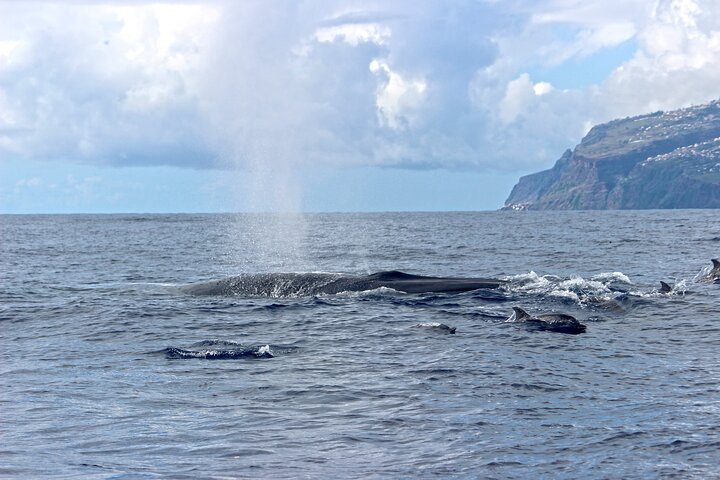
For the highest sighting rates and top reviews, choose Calheta, the 4.93★ rated Calheta operator (1,285 reviews) consistently delivers exceptional whale encounters because Calheta's deeper offshore waters have higher cetacean density. For convenience and lower cost, choose Funchal, the ecological catamaran departs from the marina you can walk to and costs just €38 If you care most about seeing whales, go to Calheta. If you want a pleasant boat trip from Funchal, the catamaran is excellent value.
Local Wisdom, The Morning I Chased Sperm Whales
🇵🇹 Before You Hike (2026 Update)
SIMplifica booking is now mandatory for all classified PR trails in Madeira. You must book online before arrival and show a QR code at the trail entry.
- Standard trails: €4.50 per person
- PR1 (Pico do Arieiro → Pico Ruivo): €10.50 per person (from April 2026)
- Book at: simplifica.madeira.gov.pt
Check trail status before you go: IFCN official trail status · IPMA weather
📌 PR1 spent part of early 2026 partially closed for rockfall repairs. It has since reopened. Always verify current status with IFCN, conditions change. Guided tours that include your trail fee are a convenient option, see recommended tours below ↓
Calheta, 8:15 AM. The boat was a rigid inflatable with twelve passengers and a marine biologist named Catarina who had been studying Madeira cetaceans for eight years. Within 40 minutes, we found a pod of Atlantic spotted dolphins, thirty or more, riding the bow wave, spinning in the air. Catarina was quietly thrilled. Then the spotter called in sperm whales, three of them, logging at the surface between dives. The largest, a female maybe 12m long, surfaced 30m from the boat. The sound of a sperm whale exhaling is something I cannot describe, a deep, wet rush that you feel in your chest. Calheta is the better departure point: deeper water closer to shore means less travel time, more time with the animals. Funchal boats spend 40 minutes just reaching the whale zone.
Calheta vs Funchal: Side-by-Side Comparison.
Calheta Whale & Dolphin Watching
Calheta's boats reach deeper water faster, within 10–15 minutes you are in prime cetacean territory. The sheltered southwest coast also means calmer seas year-round. This operator has the highest rating of any whale watching tour on the island, with biologists or marine guides on board. Sperm whales, pilot whales, bottlenose dolphins, and Atlantic spotted dolphins are seen on 90%+ of trips.
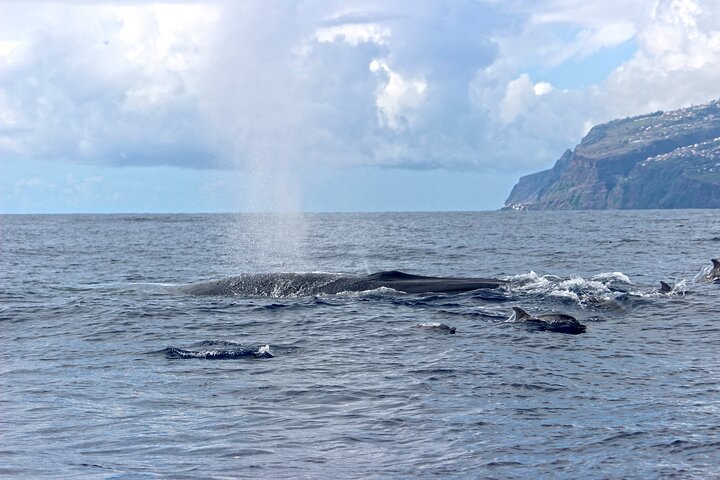
For official trail conditions and travel information, visit Visit Madeira, the UNESCO Laurissilva Forest page, and IFCN (Madeira's Institute of Forests and Nature Conservation).
Book Now →Funchal Ecological Catamaran
Departing from Funchal's marina, walkable from most hotels, this eco-catamaran is the most popular whale watching option on the island by volume. The spacious boat has shaded areas, a bar, and marine biologist commentary. It takes 20–30 minutes to reach deeper water, but once there, dolphin encounters are very reliable. A comfortable, family-friendly option at an accessible price.
⛔ Is whale watching right for you?
- Not if you get severely seasick: Even in calm conditions, offshore Madeira has swell. Take seasickness medication 30 minutes before departure.
- Not a zoo experience: These are wild animals, sightings are not highly likely, though Madeira's rates are among the highest in Europe (85–95%).
- Morning trips are better: Seas are typically calmer in the morning. Afternoon wind can make for a rougher ride.
Which Species Can You See?
Madeira's waters host both resident and migratory species year-round:
- Year-round: Bottlenose dolphins, Atlantic spotted dolphins, short-finned pilot whales, sperm whales, Bryde's whales
- Seasonal (Apr–Oct): Loggerhead turtles, striped dolphins, minke whales, occasional orcas
- Rare but possible: Blue whales, sei whales, fin whales (mainly spring migration)
What to Bring Whale Watching
Windproof jacket: The Atlantic wind at speed is cold, even in August. Sunglasses and sunscreen: Glare off the water doubles UV exposure. Seasickness medication: Take it 30 minutes before departure. I have watched too many tourists spend their trip staring at the bottom of a sick bag. Camera with a strap: You will want both hands free. Binoculars (optional): Boats get close, but binoculars let you spot blows on the horizon. Water: Most boats do not provide it. No bananas: Old sailor superstition, some Madeiran skippers genuinely will not allow them on board.
What to Expect on a Madeira Whale Watching Tour
Madeira's position in the Atlantic, 600 kilometres off the Moroccan coast, places it directly on the migratory route of several cetacean species. The waters around the island are home to a resident population of bottlenose dolphins, short-finned pilot whales, and sperm whales, while summer months bring spotted dolphins, striped dolphins, and the occasional blue whale passing through on its migration to the Azores. I've done five whale watching trips over two years and every single one has been different, partly because the animals are wild and partly because the experience depends heavily on your operator's approach.
The top operators use a hydrophone, an underwater microphone that amplifies cetacean vocalisations in real time. The first time I heard a sperm whale click through the hydrophone, it sounded like a creaking door amplified through a submarine speaker, rhythmic and deliberate. The guide explained that each click pattern is distinctive to the individual whale, like a vocal fingerprint. Spotted dolphin pods are the most common sighting (85%+ success rate), followed by pilot whales and bottlenose dolphins. Sperm whales are seen on roughly 40% of trips.
A quality whale watching tour lasts 2.5 to 3 hours and uses a catamaran with indoor and outdoor seating, a bar, and toilet facilities. The whale watching comparison page breaks down the specific operators, but the universal rule is: if a tour promises likely sightings, don't book it. Reputable operators are honest about the 85% sighting probability and don't need to overpromise.
Skip if: You're prone to seasickness, even catamarans rock in Atlantic swell. Take medication 30 minutes before departure. Also skip the budget-friendly 1-hour harbour cruises, they don't leave the marina breakwater and the animals are in open water, not the harbour. Check for hydrophone use as a quality signal: operators that invest in hydrophones are serious about wildlife.
Calheta vs Funchal at a Glance
Calheta
Funchal
Can I swim with dolphins?
Some Calheta operators offer dolphin swimming experiences (available on the €65 tour), but this is strictly regulated in Madeira. You cannot chase or touch dolphins, you enter the water and let them approach if they choose to. It is not predictable.
Which season is top for whale watching?
I've been out in every season and each has trade-offs. Spring (March to May) has the calmest seas and top visibility, which also means fewer seasick passengers. I took my first trip in late March and the Atlantic was eerily flat, not a single person got sick, and we saw sperm whales on both trips that week. Summer (June to August) has the most departure options and warmest weather, but also the most tourists and afternoon winds that can make the ride back choppy. Autumn (September to November) is my personal favourite: the water is still warm from summer, the crowds thin out, and the migratory species like pilot whales pass closer to shore. Winter (December to February) has the roughest seas and fewest departures, I only went once in January and spent half the trip holding the rail. The marine biologist told me that winter storms stir up nutrients, which can actually attract more feeding whales, but the experience isn't worth it if you're prone to seasickness.
What if I don't see anything?
It happens. On my second whale watching trip, a Funchal catamaran in August, we saw nothing for the first two hours. Just ocean. A few passengers were visibly disappointed, the kids especially. The guide handled it well: he explained the hydrophone system, talked about Madeira's marine ecosystem, and kept the mood light. At the two-hour mark, a pod of spotted dolphins appeared and everyone forgot they'd been bored. Some operators offer a partial refund or rebooking if sightings are unsuccessful, but this is rare, most only guarantee a boat ride, not wildlife. I recommend treating the trip as a boat experience that may include whales, rather than a whale guarantee. You'll enjoy it more.
Do I need to book in advance?
Yes, especially in summer (June–September) and for morning departures. The Calheta operator in particular sells out. Book at least 2–3 days ahead.
Last updated: May 28, 2026. Sighting rates are based on operator-reported data and reviews.