PR1 vs PR1.2: Which Pico Ruivo Route is Right for You?
I Did Both PR1 and PR1.2, and Here's What I Learned
🇵🇹 Before You Hike (2026 Update)
SIMplifica booking is now mandatory for all classified PR trails in Madeira. You must book online before arrival and show a QR code at the trail entry.
- Standard trails: €4.50 per person
- PR1 (Pico do Arieiro → Pico Ruivo): €10.50 per person (full route, since the 1 May 2026 reopening)
- Book at: simplifica.madeira.gov.pt
Check trail status before you go: IFCN official trail status · IPMA weather
📌 PR1 was closed for about 20 months after rockfalls and reopened on 1 May 2026, one-way only past the Pedra Rija viewpoint. Always verify current status with IFCN, conditions change. Guided tours that include your trail fee are a convenient option, see recommended tours below ↓
I drove 45 minutes from Funchal to Pico do Arieiro at 5:30 AM with a friend visiting from Lisbon, only to find the entrance blocked by an IFCN barrier and a laminated sign: "PR1 CLOSED, MAINTENANCE." We sat in the car, defeated, scrolling for alternatives. The backup plan became PR1.2 from Achada do Teixeira, just 2.8km each way, about 270m of climbing, and the same Pico Ruivo summit waiting at the end. It wasn't the full traverse, but we stood on Madeira's highest point watching the sunrise with about 20 other people who'd had the same idea. The clouds were below us. The silence was complete. My friend said it was actually better because we could sit at the summit for an hour instead of rushing through the staircase section on a schedule. Now I always scout PR1.2 as the official backup plan.
We earn a commission when you book through our links on Viator (PID P00303273), at no extra cost to you. This is how we keep the site free.
Over the next three weeks, I went back and did PR1 properly, the full Pico do Arieiro to Pico Ruivo traverse. And then I did PR1.2 again, just to be sure which I'd recommend. Here's the simple 30-second decision framework, then the detailed look into each route.
Quick answer
- Do PR1 if you're fit, fine with heights and long staircases, and want the full ridge walk. Since 1 May 2026 the full route is one-way, so you finish at Achada do Teixeira, on the far side of the mountain from your car at Pico do Arieiro. Sort out the return before you go. The easiest fix is a shared transfer that drops you at Arieiro and collects you at Teixeira. Take the morning transfer to skip the pre-dawn start, or the sunrise transfer if you want sunrise at Arieiro. Both pick up in Funchal and Caniço only.
- Do PR1.2 if you want the summit with less effort, have knee trouble, or are short on time. It's an out-and-back from the Achada do Teixeira car park, so you can drive yourself and don't need a tour.
Either way, book your SIMplifica trail slot first (see the 2026 box above). Neither transfer includes the trail fee.
| Feature | PR1 (Arieiro → Ruivo) | PR1.2 (Achada → Ruivo) |
|---|---|---|
| Distance (one-way) | 6.1km | 2.8km |
| Elevation gain | ~370m, after dropping to 1,491m | ~270m |
| Duration | About 3 hours | 1.5 hours round trip (official IFCN time) |
| Difficulty | Officially moderate, but steep staircases, tunnels and vertigo sections | Moderate, steady climb on a paved path |
| Top for | Fit hikers who want the full ridge traverse and sunrise | Anyone who wants the summit with minimal effort, families, vertigo sufferers |
| Not for | Anyone with knee problems, vertigo, or tight schedules | Experienced hikers seeking a challenge |
| Parking | Pico do Arieiro carpark (~60 cars, free). Overflow at radar station 500m before. | Achada do Teixeira carpark (~40 cars, free) |
| Sunrise option | Yes, with transfer service (see below) | Yes, but you drive yourself, less crowded |
Verdict in 30 seconds: If you're fit, have 4+ hours, and want the famous sunrise ridge traverse, do PR1 with a sunrise transfer. If you want the summit with zero drama, have knee problems, or are short on time, do PR1.2. Both end at the same peak.
Pico do Arieiro Sunrise Transfer + Hike, The PR1 Experience
I started PR1 on a cloudless morning in April, t-shirt weather at the Arieiro carpark, sunglasses on, feeling smug about my timing. By the time I reached the tunnel at the 2km mark, the temperature had dropped 12°C and I was walking through freezing fog so dense I couldn't see the next trail marker. The microclimate shift happens at the ridge between Arieiro and Ruivo, the north coast weather spills over like a lid coming off a pot. I finished the hike shivering in a thin rain jacket I'd almost left in the car. Now I carry a proper thermal layer on PR1 every single time, even when Funchal is 28°C.
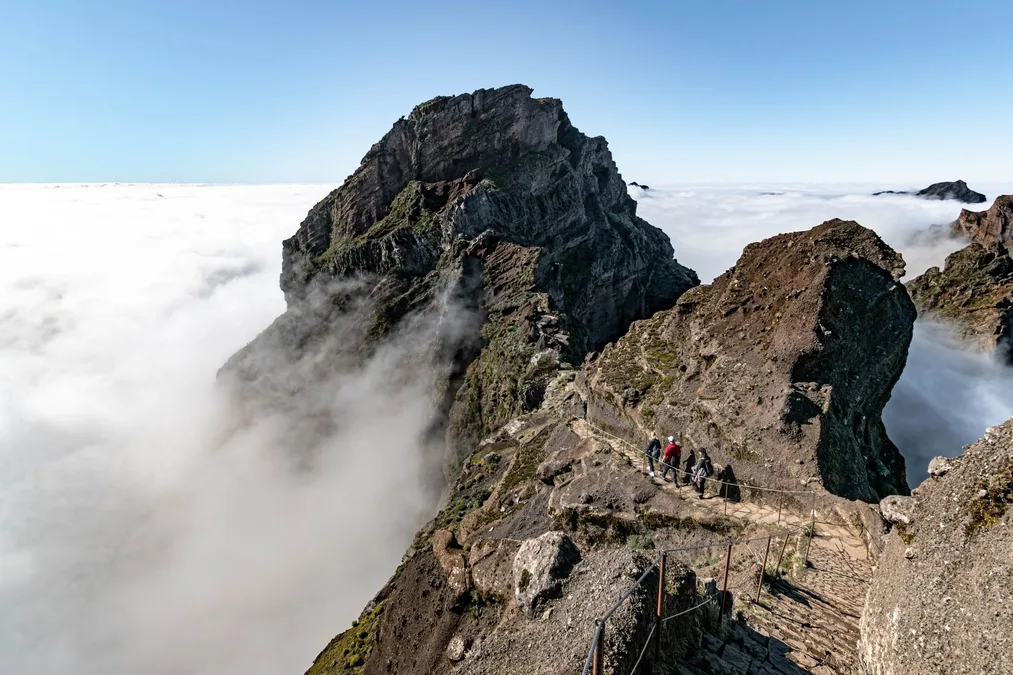
The PR1 route from Pico do Arieiro (1,818m) to Pico Ruivo (1,862m) is 6.1km of relentless staircases, pitch-black tunnels, and sections where the path narrows to 1m with a 200m drop on either side. The tunnels are completely dark, and some have uneven floor sections with pooling water. Bring a headlamp if you have one; it frees both hands for the uneven footing. The tunnels also collect cold air, temperature drops noticeably inside.
I booked the Pico do Arieiro Sunrise Transfer + Hike for my second attempt. The van collected me in Funchal and had me at the summit well before sunrise, and I watched it come up above an ocean of clouds. It was extraordinary, but the experience was closer to a concert crowd than a wilderness moment. At the viewpoint I found 200 people lined along the viewing platform, tripods everywhere, someone playing music from a Bluetooth speaker, and a queue for the must-have photo at the stone archway. If you want solitude, go on a weekday in November, arrive at 5:30 AM to get ahead of the crowd, or hike 15 minutes past the viewpoint toward Ruivo where the crowd thins to 5% of what's at the summit.
Pico do Arieiro Sunrise Transfer + Hike
The smart way to do PR1. You arrive at Pico do Arieiro about 50 minutes before sunrise, hike to Pico Ruivo at your own pace, then down to Achada do Teixeira, where you get picked up. No logistical headache of returning to your car. Not for anyone with knee problems, those staircases are brutal on the descent.
Book Now →Who it's NOT for: Anyone with knee problems, vertigo, or a tight schedule. The long stone staircases down into the saddle will wreck your knees. If you have any hesitation about heights, skip this one, the exposed sections are real. And if you're on a tight timeline, the 3-hour one-way hike plus transfer time eats a whole morning.
Going with PR1.2? My full PR1.2 guide covers the permit, timing and what to bring.
Going with PR1? My full PR1 guide covers the one-way rule, the permit and the transfer options.
Why PR1 Nearly Won Me Over
The ridge traverse between Arieiro and Ruivo is genuinely one of the most dramatic hikes I've done anywhere. The views of the north coast, the central massif, and the ocean are constant throughout. The tunnels add a sense of adventure. And finishing at Madeira's highest point after that effort feels earned in a way that the PR1.2 walk-up doesn't. But: the PR1.2 option gives you the exact same summit view for a quarter of the effort. And on a busy day, the summit experience is identical, you're standing at the same peak with the same 360-degree panorama. The question is whether the journey matters more to you than the destination.
The PR1.2 Trail Experience: Achada do Teixeira to Pico Ruivo
PR1.2 from Achada do Teixeira is the compromise that doesn't feel like one. The trail is 2.8km each way, with about 270m of climbing. It's a wide, well-maintained path that gently climbs through heather and volcanic rock. No tunnels, no vertigo sections, no staircases. The summit of Pico Ruivo (1,862m) is visible from the trailhead, you can see exactly where you're going the whole time. I've done it with a friend who has mild vertigo and she had no issues. I've also seen families with children aged 8-10 on the trail, moving at their own pace.
The Madeira Sunrise Hike PR1 tour I tried on a return visit was the full PR1 experience with a guide and a group capped at 8. The guide paced the group well, but if you're a fast hiker, you'll be frustrated waiting at every switchback. If you want social context with your cardio, it's a solid choice. But for pure summit access, PR1.2 on your own is simpler and cheaper.
Madeira Sunrise Hike PR1
The full PR1 experience with a guide. Covers the classic Arieiro → Ruivo route at sunrise, often above the clouds. Groups are capped at 8. The guide paces the group, so you won't get left behind, but you also can't rush ahead.
Book Now →Who it's NOT for: Experienced hikers who want a challenge, you'll finish PR1.2 in an hour and feel like you barely broke a sweat. Also not for anyone who wants solitude at the summit on summer weekends; the Achada trailhead gets busy too, though less so than Arieiro.
The Moment I Made My Decision
It was my third week on the island. I'd hiked PR1 twice and PR1.2 once. I learned something those first three weeks that no guidebook mentions: the real difference between PR1 and PR1.2 isn't the distance, it's the kind of tired you are at the end.
I was driving back from the north coast after checking trail conditions at the Paul da Serra picnic area, there's a free public water refill station there, near the Rabaçal turn-off, worth knowing about. I pulled over at the BP station on the ER103 junction just before the Pico do Arieiro turning. The guy running the place makes proper espresso, not vending machine instant. He asked where I'd been. I told him I was comparing the two routes. He laughed and said, "Tourists always ask me which one. I tell them: do the short one, have a coffee at the top, and come down before lunch. The long one is for people who want to say they did it."
He was right. The decision comes down to whether you want the journey or the destination. If you want the journey, the ridge traverse, the tunnels, the sense of accomplishment, do PR1. If you want the destination, standing on Madeira's highest point with minimal fuss, do PR1.2. Both end at the exact same summit. The view is identical. The selfie is the same. The only difference is how much you suffer to get there.
For most people, I recommend PR1.2. It's the better value proposition: less time, less effort, less risk of injury, and you still get the top view on the island. Do PR1 only if you're fit, have no knee issues, and specifically want the traverse experience. And if you do PR1, book the sunrise transfer, driving yourself back from Achada after the descent is miserable.
Where to Park for PR1: Pico do Arieiro Parking Guide (2026)
Parking is the part of PR1 that ruins mornings, so let me spell it out. The main lot at Pico do Arieiro has roughly 60 spaces and it's free. There's an overflow area by the radar station 500m before the summit with about 20 more spaces, also free, but once both fill, you're parking on the shoulder of a narrow mountain road, which I don't recommend and the GNR occasionally tickets.
Arrive by 7:00 AM on weekdays, 6:00 AM on weekends. After 8:00 AM in summer, you're circling for 20+ minutes, and by then you've also lost the cool morning hours and the clear views, cloud typically rolls in over the peaks by late morning.
If you drive up and Arieiro is full, don't waste an hour waiting for a space. Turn around and drive to Achada do Teixeira instead and do PR1.2, I've covered that route above, and its car park almost never fills. You still summit Pico Ruivo, the hike is shorter, and you skip the parking fight entirely.
Now the problem nobody thinks about until they're standing on Pico Ruivo: if you parked at Arieiro and hiked the full traverse one-way, your car is 6.1km of brutal staircases behind you. You have two options. A taxi from Achada do Teixeira back to Arieiro runs €40–50 and you'll need to arrange it in advance, there's no rank waiting up there. Or book a one-way transfer tour that drops you at Arieiro and collects you at the other end, which is what I recommend to anyone who wants the full traverse. Hiking back the way you came is no longer an option: since the 1 May 2026 reopening, the full PR1 route is one-way from the Pedra Rija viewpoint onwards.
Solve the parking headache: sunrise transfer from Funchal includes pickup and drop-off →
One last thing before you drive up: check the IFCN trail status page the night before. PR1 closes after storms, landslides, and during fire risk, and the closure gate is at the trailhead, meaning you can fight for parking at 6:30 AM only to find the trail shut. Two minutes on ifcn.madeira.gov.pt saves you the whole wasted morning.
What I Wish I'd Known Before I Went
- Check IFCN trail status the morning of your hike. I've been turned away from PR1 at 5:30 AM, the closure sign goes up overnight after rain.
- PR1 tunnels are no joke. They are pitch black, and some have uneven floor sections with pooling water. Bring a headlamp, phone flashlight works but frees one hand. The temperature drops noticeably inside.
- Parking fills early. PR1 Arieiro carpark holds ~60 cars, free. PR1.2 Achada do Teixeira holds ~40 cars, free. If PR1 parking is full, park at the radar station 500m before and walk up. The overflow adds ~20 spaces.
- Buy hiking poles at Decathlon in Funchal. Madeira Shopping mall, floor 2. Basic aluminum poles: €12.99. The tourist shop at the PR1 Arieiro summit kiosk sells the same poles for €35. Don't be that person.
- Padaria do Monte opens at 5 AM. Grab a fresh bolo do caco with garlic butter before your sunrise hike. It's on your way to Arieiro if you're staying in Funchal. There's also a small pastelaria on the ER103 called Padaria do Arieiro, no sign in English, just a faded "Pão" painted on the wall. It opens at 5:30 AM. The owner, Dona Rosa, knows every hiker who passes through. She'll ask "Arieiro?" and if you nod, she'll pour a bica that's half the price of the tourist cafes in Funchal and triple the quality.
- Mobile coverage is spotty on both trails. PR1 (Arieiro to Ruivo) has better coverage on the Arieiro side, mostly dead zone in the saddle between peaks. PR1.2 has intermittent signal. Download offline maps on Google Maps or Komoot before you leave your accommodation.
- Rent a proper car. A manual 1.2L+ petrol is essential. The PR1 access road has 40+ hairpin turns with 20% gradients. A Fiat 500 will struggle. Europcar and Guerin allow their standard fleet on mountain roads; Goldcar and Sixt explicitly forbid driving on ER101 and ER110 in their small-print.
- Nearest medical post to PR1 Arieiro: Funchal Hospital Dr. Nélio Mendonça, 18km, 35 min drive. For PR1.2: Centro de Saúde de Santana (urgent care), 12km, 20 min drive. Know this before you go.