For official trail conditions and travel information, visit Visit Madeira, the UNESCO Laurissilva Forest page, and IFCN (Madeira's Institute of Forests and Nature Conservation).
I've stood at 1,818m on Pico do Arieiro watching the sun turn the cloud layer from grey to gold to blazing orange. I've also stood there in freezing fog so thick I couldn't see the person next to me. Madeira's summits reward preparation and punish complacency.
We earn a commission when you book through our links on Viator (PID P00303273), at no extra cost to you. This is how we keep the site free.
After walking 400+ km of Madeira trails, the summit hikes remain my favorites, but they also require the most planning. The central massif above 1,400m is a different world from the coast. Temperatures drop 8-12°C from Funchal. Wind speeds of 40-60 km/h are common by afternoon. And the microclimates don't care about your expectations, I started PR1 in April in a t-shirt at the Arieiro carpark and reached the tunnel at 2km shivering in freezing fog that dropped the temperature 12°C.
The big question: sunrise transfer vs self-drive? The sunrise transfer (€35-50) drops you at the summit at 6 AM, gets you one-way to Ruivo, and picks you up at the far end. Self-driving means arranging a second car or a pre-booked taxi from Achada do Teixeira, because PR1 has been one-way since it reopened on 1 May 2026. The transfer is the smart play for 90% of visitors. I recommend booking a sunrise transfer hike for the full experience.
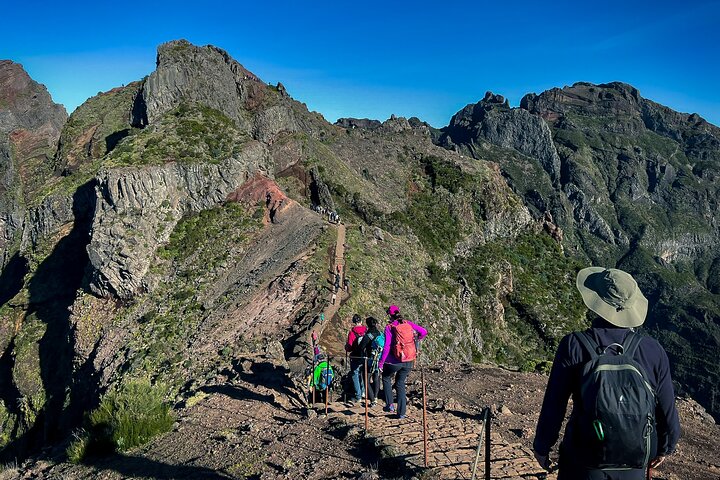
PR1 vs PR1.2: Fit and brave? Do PR1, the full 6.1km one-way traverse with pitch-black tunnels and exposed ridges. Short on time or knees? Do PR1.2 from Achada do Teixeira, 2.8km each way with about 270m of climbing, same Pico Ruivo summit. I did PR1 in late September with a group of six. The sunrise was perfect, we stood above a sea of clouds watching the shadow of Pico Ruivo stretch across the valley. The staircase section tested everyone's knees, but the sense of crossing Madeira's rooftop stayed with us long after the ibuprofen wore off.
Taking the shorter route? My PR1.2 guide from Achada do Teixeira covers the permit, timing and what to bring.
Doing the full ridge? My PR1 guide covers the one-way rule, the permit and how to get back from Achada do Teixeira.
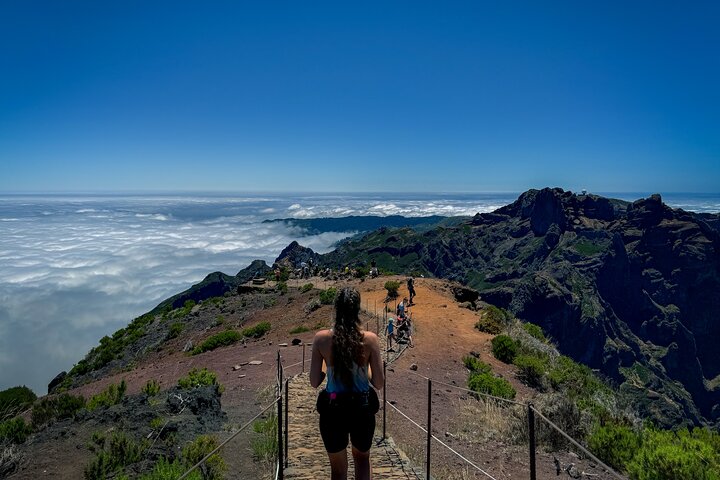
The Arieiro sunrise reality: The Instagram version shows a lone hiker silhouetted against a burning sky. The reality: I arrived at 6:15 AM in July and found 200+ people lined along the viewing platform, tripods everywhere, someone playing music from a Bluetooth speaker, and a queue for the famous shot. The sunrise itself was impressive, but the experience was closer to a concert crowd than a wilderness moment. If you want solitude, go on a weekday in November or hike 15 minutes past the viewpoint toward Ruivo where the crowd thins to 5%.
Essential gear for summit hikes: Head torch (non-negotiable, tunnels on PR1), thermal base layer, windproof jacket, 2L water minimum, hiking boots with good grip. There's a small pastelaria on the ER103 called Padaria do Arieiro, no sign in English, just faded "Pão" painted on the wall. Opens at 5:30 AM, finest pre-hike coffee on the mountain road. Owner Dona Rosa pours a bica that's half the price of Funchal cafes and triple the quality. Look for the blue awning 3km before the Arieiro turn-off on the left.
From the famous Pico do Arieiro sunrise to lesser-known summit routes, these comparisons cover what you actually need to know before booking, parking logistics, guided vs self-drive trade-offs, and seasonal weather windows.
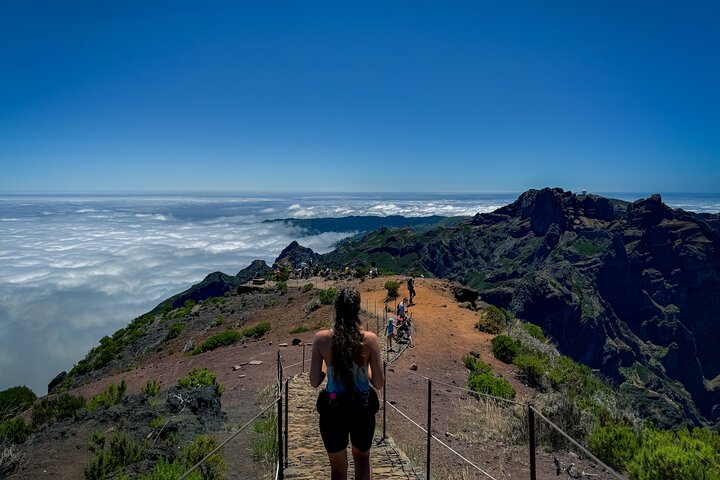
What to Bring on Madeira Summit Hikes
🇵🇹 Before You Hike (2026 Update)
SIMplifica booking is now mandatory for all classified PR trails in Madeira. You must book online before arrival and show a QR code at the trail entry.
- Standard trails: €4.50 per person
- PR1 (Pico do Arieiro → Pico Ruivo): €10.50 per person (from April 2026)
- Book at: simplifica.madeira.gov.pt
Check trail status before you go: IFCN official trail status · IPMA weather
📌 PR1 spent part of early 2026 partially closed for rockfall repairs. It has since reopened. Always verify current status with IFCN, conditions change. Guided tours that include your trail fee are a convenient option, see recommended tours below ↓
- Head torch with fresh batteries, not your phone flashlight. The PR1 tunnels are pitch black. Your phone light is not enough. I have seen people turn back at the tunnel entrance because they assumed their phone would suffice.
- 2 litres of water minimum, not 1.5. The summit routes have no water sources. I ran out at the 4km mark on PR1 in April and spent the last 2km rationing sips. The extra 500ml weighs 500g. Carry it.
- A buff or neck gaiter. The wind at 1,800m turns the summit ridgeline into a wind tunnel. A buff pulled over your ears and nose makes the difference between enjoying the view and counting the minutes until you can descend.
- Glucose tablets or dried figs. Madeira's summit trails involve sustained climbing on stone staircases. Your legs will burn. A quick sugar hit at the 3km mark restores concentration for the exposed ridge sections where you need it most.
Counterintuitive tip: Leave the hiking poles in the car for PR1. The ridge sections narrow to 1m with cables and chains on both sides, poles get tangled in the cables and become a liability. For PR1.2 and the descent, poles help enormously, but for the traverse itself, your hands need to be free for the safety cables.
Porto Moniz, Seixal, Fanal Forest, Cliff Skywalk in Open Roof 4X4
3788 reviews · 4.92★ avg · from €79/person
Top-rated experience in the area. Great reviews, excellent value.
Book Now →Explore More
Related comparisons and guides:
- Hiking in Madeira With Kids: Which Trails Are Actually Family-Friendly?
- Family-Friendly Hiking in Madeira, Safe, Easy Trails for Kids
- First Time Hiking in Madeira, Essential Tips for Beginners
- Top Madeira Hikes for Photographers, Capturing the Island's Landscapes
- Ponta de São Lourenço (PR8) Hiking Guide: The Coastal Trail With No Shade
- 3 Top Hiking Tours in Madeira: PR1, PR11 Balcões & 25 Fontes PR6
- What to Pack for Hiking in Madeira: The Complete Gear Guide
- Madeira in Winter: What to Hike (and What Not to) November to February